History: MultiLangVsNetCodeAnalysisCodeFix
Preview of version: 4
Multi-Language for Visual Studio
Code Analysis and Code Fix
Starting with Version 7.2, Multi-Language for Visual Studio contains a code analysis and several associated code fixes.
What does it check?
Every code analysis checks a rule. Lets start by looking at what the rule is.
Every string in your source code should be either
- localized or
- marked as not requiring localization (hidden)
Why is this important?
In particular, why is it important to mark strings which do not require localization?
This is important for two reasons:
It's the programmer's job
Your source code probably contains some strings which require localization, but it will probably contain some strings which should not be localized. In fact, it may contain strings which must not be localized, because doing so would break the functionality of the program.
Figuring out which strings require localization, and which do not, is best performed by the original programmer.
You only want to do it once
After version 1 of your program has been localized and released, you are probably going to make some changes and at some point release a version 2.
Version 2 probably contains some new strings which require localization.
If you had previously (in version 1) marked the strings which do not require localization, then it will be fairly easy to find any new strings added in version 2.
If you did not mark the strings which do not require localization, then you might end up looking at every one of them again, to decide whether or not it requires localization.
What is a code analysis?
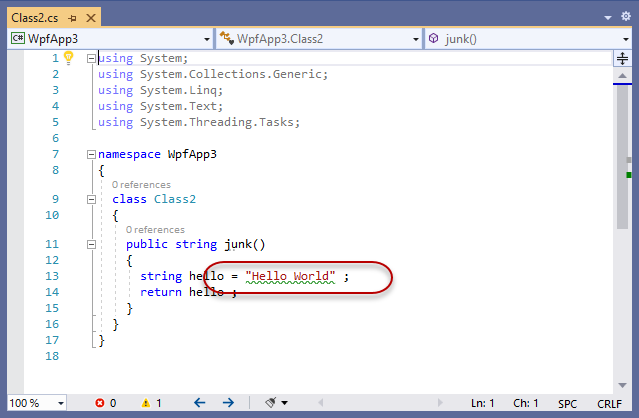
A code analysis is a rule that is applied in the background. If the rule is violated, then the code which violates the rule is underlined with a wavy green line.